
There’s a reason earthy architecture keeps returning.
Not as a trend—but as a correction.
In an industry that has spent decades chasing smooth finishes, engineered perfection, and material uniformity, there’s a growing desire to bring back something more grounded. Something that feels less manufactured and more formed.
That’s where rammed earth architecture has found renewed attention.
But interestingly, most contemporary projects are not going back to traditional rammed earth construction in its original form. Instead, they are exploring something more adaptable:
Not as a compromise—but as a way to carry the same material expression into modern construction realities.
What Is Rammed Earth Cladding?
At its core, rammed earth is a construction technique where natural soil—typically a mix of clay, sand, and gravel—is compacted in layers to form solid walls.
What makes it distinctive is not just the material, but the process.
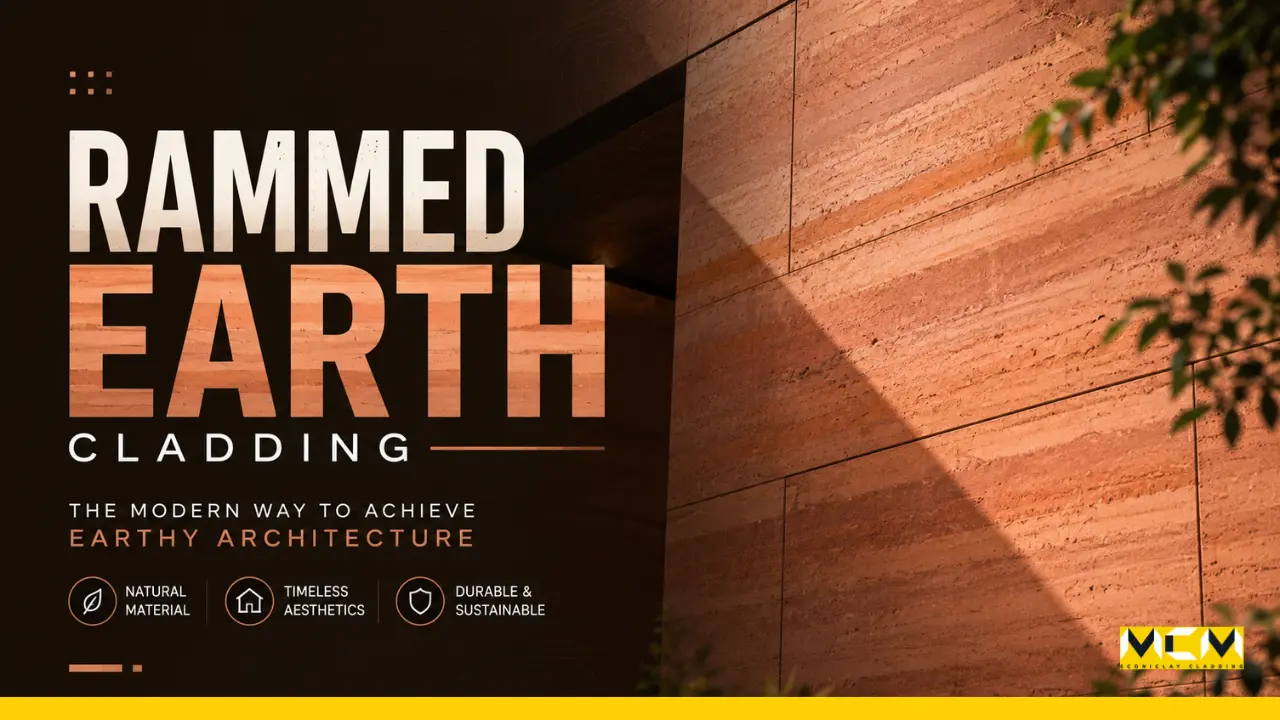
Each layer leaves behind a visible stratification. Slight variations in soil composition create tonal differences. The wall becomes a record of its own making.
Rammed earth cladding, however, is a more contemporary adaptation.
Instead of using rammed earth as a structural wall, the material—or its expression—is applied as an external or internal cladding layer.
This allows architects to achieve:
- the layered texture
- the earthy tonal variation
- the visual weight
without relying entirely on traditional construction methods.
Why Earth-Based Aesthetics Are Returning
To understand the rise of rammed earth cladding, it’s worth stepping back.
Modern architecture has long been defined by materials like:
- glass
- concrete
- steel
- composite panels
These materials brought efficiency, scale, and consistency.
But they also introduced a certain detachment.
Buildings began to feel less connected to their environment—and more like objects placed within it.
Earth-based materials change that.
They:
- absorb light rather than reflect it
- age gradually rather than abruptly
- carry irregularity instead of perfection
This creates a different kind of presence.
Not loud. Not polished. But grounded.
The Design Appeal of Rammed Earth Cladding
There’s a reason architects are drawn to this material expression.
It’s not just about sustainability. It’s about how the facade behaves visually.
1. Layered Texture That Evolves with Light
Unlike flat finishes, rammed earth surfaces interact with light throughout the day.
Morning light brings out subtle tonal shifts. Harsh afternoon light reveals depth. Evening shadows exaggerate the layering.
The facade is never static.
2. Natural Colour Without Artificial Finishes
The tones in rammed earth come from the material itself.
Ochres, browns, greys—these are not applied colours. They are inherent.
This reduces reliance on coatings or paints, allowing the material to remain authentic in its expression.
3. Strong Visual Anchoring
Earth-based facades have weight.
Not just physically, but perceptually.
They ground a building. They connect it to landscape. They make it feel like it belongs—rather than sits.
The Practical Challenges of Traditional Rammed Earth
And this is where reality begins to intervene.
While rammed earth offers undeniable aesthetic and environmental value, it also comes with limitations—especially in contemporary construction.
Structural Constraints
Rammed earth is heavy. Using it structurally requires careful engineering, which may not be feasible in all projects.
Execution Complexity
The process is labor-intensive and dependent on skilled workmanship. Consistency can be difficult to achieve across large surfaces.
Time-Intensive Construction
Layer-by-layer compaction takes time. This can conflict with modern construction timelines.
Environmental Sensitivity
Moisture, erosion, and long-term durability require careful detailing and protection.
Why Rammed Earth Cladding Makes More Sense Today
This is where the shift toward rammed earth cladding systems becomes relevant.
Instead of using earth as a structural material, architects are now focusing on achieving its expression through facade cladding.
This approach offers a balance.
You retain:
- the visual depth
- the layered texture
- the earthy tones
But gain:
- faster construction
- greater control over finish
- compatibility with modern facade systems
It’s not about replacing rammed earth.
It’s about adapting it to contemporary building practices.
Comparing Rammed Earth Cladding with Other Materials
When positioned alongside other exterior wall cladding materials, rammed earth—or its alternatives—occupies a unique space.
vs Stone Cladding
Stone cladding offers durability and natural texture, but it introduces significant weight and installation complexity.
Rammed earth cladding provides similar grounding aesthetics with potentially more visual softness.
vs Brick Cladding
Brick cladding is structured and repetitive. It brings rhythm, but less variation.
Rammed earth, in contrast, is fluid and layered—less about pattern, more about surface.
vs Wood Cladding
Wood cladding introduces warmth but requires maintenance and is sensitive to weathering.
Earth-based finishes offer warmth without the same level of upkeep.
vs ACP or Metal Panels
Modern materials like ACP provide efficiency and clean finishes—but often lack material depth.
Rammed earth cladding sits on the opposite end—rich in texture, low in artificiality.
Where Rammed Earth Cladding Works Best
This material expression is not universal. It works best when used intentionally.
You’ll typically see it in:
- nature-integrated homes
- boutique hospitality projects
- institutional buildings focused on sustainability
- low-rise residential architecture
It performs particularly well in projects where:
- the building interacts closely with landscape
- material authenticity is a priority
- visual calmness is desired
The Role of Modern Material Alternatives
Here’s where things get interesting.
As demand for earthy architecture grows, architects are not always choosing traditional rammed earth construction.
Instead, they are exploring modern facade cladding materials that replicate or reinterpret this expression.
This is not about imitation.
It’s about solving practical constraints while preserving design intent.
Materials like mineral-based and modified clay cladding allow for:
- controlled finishes
- lighter systems
- faster execution
- adaptability across surfaces
They carry the idea of rammed earth—without requiring the same construction process.
Where MCM Cladding Comes Into the Conversation
In this context, solutions like MCM Cladding (Phomi MCM India) begin to make sense.
Our range includes rammed earth-inspired cladding surfaces—such as products like
- Rammed Earth Wall Egyptian Yellow
- Rammed Earth White
- Rammed Earth Yellow Grey
- Rammed Earth Light Grey
- Rammed Earth Red
- Rammed Earth Wall Medium Grey
- Rammed Earth Wall Brownish Red
that bring this material language into real projects.
These are not traditional rammed earth walls.
They are:
- modified clay cladding systems
- lightweight and flexible
- suitable for exterior wall cladding and interiors
- designed for modern construction environments
This allows architects to:
- achieve earthy aesthetics
- maintain construction efficiency
- work across varied building types
And importantly—execute the design without compromise.
Final Thought
Rammed earth is not just a material.
It’s a philosophy.
It represents a way of building that is closer to the ground, more responsive to environment, and less dependent on artificial finishes.
But architecture doesn’t stand still.
As construction methods evolve, materials must adapt.
Rammed earth cladding is part of that evolution.
It allows architects to retain the essence of earthy architecture—while working within the realities of modern design, timelines, and performance expectations.
Because in the end, good architecture is not about choosing between tradition and innovation.
It’s about knowing how to carry one into the other—without losing what made it valuable in the first place.