
For a long time, we’ve been designing facades as statements.
Glass for modernity. Stone for permanence. Metal for precision.
And then, somewhere else in the building, we tried to fix the consequences.. thicker insulation, heavier HVAC systems, more energy consumed to compensate for what the facade allowed in.
That separation doesn’t work anymore.
Today, the facade is not just the skin of the building. It is its first line of negotiation with climate. Every ray of sunlight, every shift in temperature, every movement of air meets the building here, long before it reaches the interior.
Which is why facade cladding is no longer just about appearance.
It is about control.
The Facade as a Living Boundary
A building is never static. It is constantly responding.
As the sun moves, surfaces heat up. As temperatures drop, that heat begins to escape. Materials expand, contract, absorb, and release energy in cycles that repeat every day.
What sits at the center of this exchange is the exterior wall cladding system.
Not as a barrier — but as a mediator.
A well-designed facade cladding system doesn’t just block heat. It manages it. It slows it down, redirects it, sometimes even uses it. And in doing so, it reduces the burden placed on mechanical systems inside.
This is where energy efficiency begins — not in machines, but in material behavior.
Heat Is Not the Problem — Uncontrolled Heat Is
In most climates, especially across India, buildings don’t suffer from a lack of insulation. They suffer from excessive and poorly managed heat gain.
When sunlight hits a facade, what happens next depends entirely on the material.
Some surfaces absorb it aggressively.
Some reflect a portion of it.
Some store it — only to release it hours later, when the interior should ideally be cooling down.
This is why materials like natural stone cladding, despite their visual richness, can complicate thermal performance. Their density allows them to hold heat, extending its impact beyond the hours of direct exposure.
On the other end, ACP cladding systems behave differently. They heat up quickly, but their performance relies heavily on coatings and what sits behind them — insulation, air gaps, structural detailing.
Neither is inherently right or wrong.
The real issue is not heat itself.
It is how long the facade allows that heat to remain part of the building.
Where Systems Begin to Matter More Than Materials
There’s a point in every project where choosing a material is no longer enough.
Because a facade is never just a material.
It is always a system.
How that system is assembled — the gaps it allows, the layers it introduces, the way it breathes — begins to matter more than what it is made of.
This is why ventilated facade systems have become central to energy-efficient architecture.
By introducing an air cavity between the cladding and the structure, the facade gains something it never had before:
👉 the ability to release heat before it enters the building.
Warm air rises. The cavity allows it to escape. The surface remains active, not stagnant. And the interior, almost quietly, remains cooler.
It’s a simple shift — but one that redefines how modern facade cladding performs.
The Weight of a Material Is Also Its Thermal Behavior
We often think of weight in structural terms.
But in facades, weight carries thermal consequences.
Heavy materials, like stone, don’t just add load to the structure — they also add time to heat transfer. They absorb heat slowly, and release it slowly. Which means the building continues to feel its effect long after the sun has moved.
Lighter systems behave differently.
They respond faster. They don’t store as much heat. They allow the facade to reset more quickly between day and night cycles.
This is one of the reasons why contemporary facade cladding design is gradually moving toward lighter, more adaptable materials — not just for ease of installation, but for thermal responsiveness.
Surface Matters More Than We Admit
Two facades can be made of the same material — and perform completely differently.
The difference often lies in the surface.
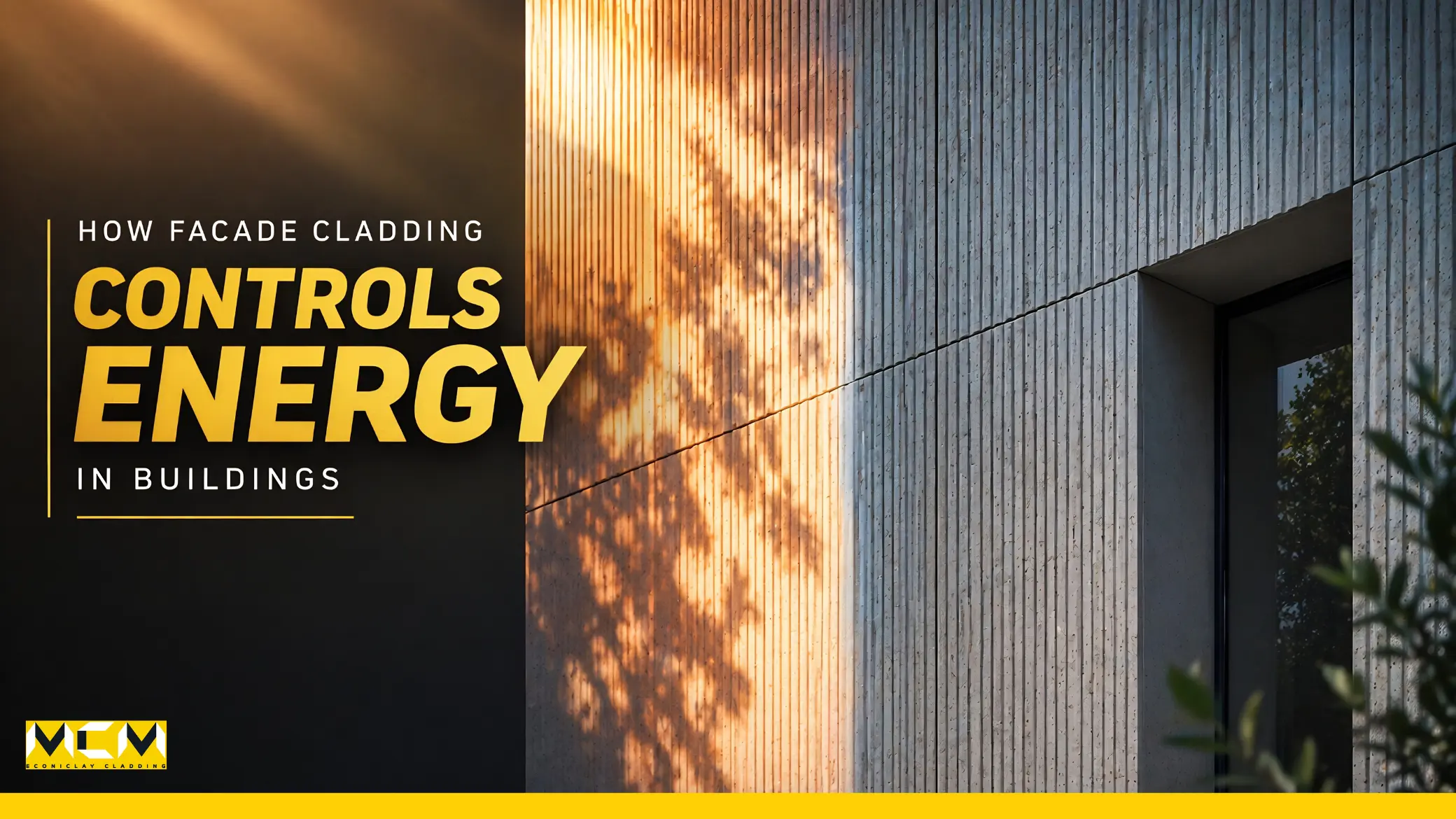
A darker finish absorbs more radiation. A reflective surface deflects it. A textured surface breaks it up.
This is where facade design becomes less about material selection, and more about how that material is expressed.
Energy efficiency, in this sense, is not hidden.
It is visible — in how light interacts with the building.
The Quiet Limitation of Conventional Materials
Materials like stone and ACP continue to dominate large parts of the industry — and for good reason. They are familiar, proven, and widely understood.
But as buildings become more complex — in geometry, in performance expectations, in environmental response — their limitations begin to surface.
Stone resists flexibility.
ACP remains surface-driven.
Both can perform well — but only within certain boundaries.
And when projects move beyond those boundaries, the facade begins to feel constrained.
A Different Direction in Facade Thinking
What’s changing today is not just the materials being used — but the way we think about them.
Instead of asking, “Which material should we use?”, the question is becoming:
“What does the facade need to do?”
Does it need to bend?
Does it need to reduce load?
Does it need to allow ventilation?
Does it need to carry a natural expression without behaving like a heavy material?
This shift has opened the door to mineral-based and clay-based facade systems — materials that don’t try to imitate traditional surfaces, but reinterpret them.
Where MCM Cladding Comes Into the Conversation
Within this evolving landscape, systems like MCM Cladding (also known as MCM Phomi India) begin to make sense — not as replacements, but as responses.
They approach the facade differently.
Instead of treating it as a rigid assembly of panels, they allow it to behave as a continuous, adaptable surface — one that can carry natural textures while remaining lightweight and flexible.
From an energy perspective, this has subtle but important implications.
A lighter system reduces structural demand, yes — but it also allows greater freedom in how the facade is detailed. Ventilation layers become easier to integrate. Complex geometries don’t disrupt performance. The facade can do more — without becoming heavier.
And in energy-efficient design, that ability to adapt is often more valuable than the material itself.
Energy Efficiency Is Not an Add-On
It’s easy to think of energy efficiency as something that gets added later — through systems, certifications, or technologies.
But in reality, it is embedded in the earliest decisions.
The facade is one of them.
Every choice made at this level — material, system, detailing — either reduces or increases the burden on everything that follows.
Which means facade cladding is not just part of the solution.
In many ways, it defines it.
Final Thought
The role of the facade is changing.
It is no longer enough for it to look right.
It has to behave right.
Because buildings today are expected to do more — consume less energy, respond to climate, remain comfortable without excessive dependence on mechanical systems.
And that shift begins at the surface.
Not as a finish.
But as a system that understands the environment it exists in.
That is where real efficiency begins.
Frequently Asked Questions
Facade cladding, stone cladding, energy efficiency in buildings, ventilated facade systems, and modern cladding systems.
Facade cladding influences energy efficiency in buildings by controlling heat gain, heat loss, and airflow. A well-designed exterior wall cladding system reduces reliance on mechanical cooling systems.
An exterior wall cladding system regulates heat transfer between indoor and outdoor environments, improving thermal performance and maintaining stable interior temperatures.
Ventilated facade systems include an air gap between cladding and structure, allowing hot air to escape. This reduces heat buildup and improves building energy efficiency.
Yes, natural stone cladding absorbs and stores heat due to its density, releasing it slowly and affecting indoor temperatures over time.
Lightweight facade cladding materials respond faster to temperature changes and do not retain heat for long durations, improving overall energy efficiency.
Surface finish affects how facade cladding interacts with sunlight. Dark surfaces absorb more heat, while reflective finishes reduce heat gain and improve performance.
ACP cladding systems are lightweight but rely heavily on coatings and insulation layers. Their energy performance depends on how the complete facade system is designed.
Facade design determines how a building interacts with climate. A well-designed facade reduces energy consumption and enhances indoor comfort.
Mineral-based facade cladding systems use natural materials like clay to create lightweight, flexible surfaces that improve thermal responsiveness.
An energy-efficient facade cladding system considers material behavior, surface finish, ventilation layers, and climate response to control heat effectively.