

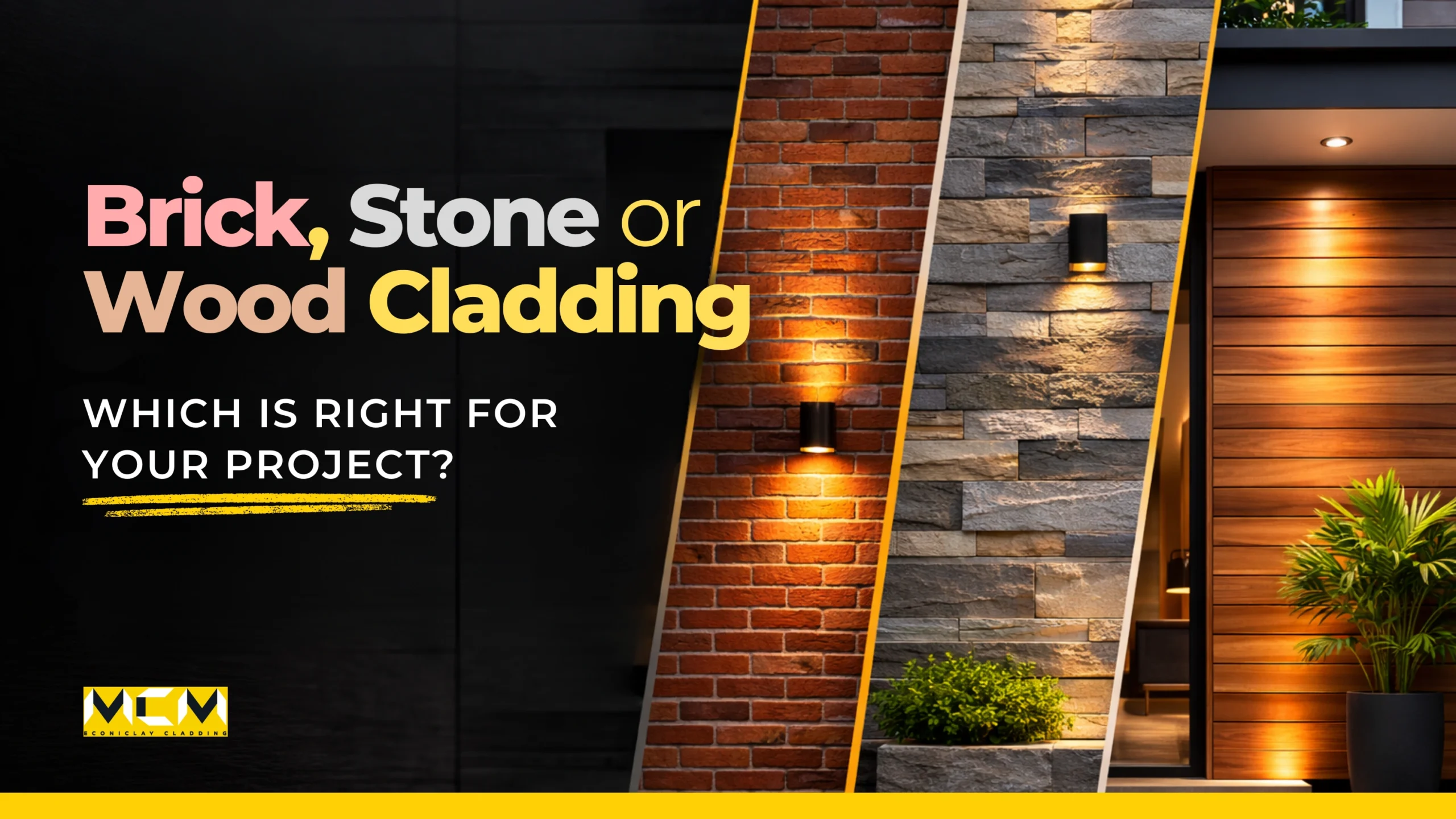
Stand in front of three buildings; a brick residence, a stone-clad hotel, and a wood-finished contemporary home, and you’ll notice something immediately. Each one communicates a different emotion before you ever step inside.
Brick feels grounded and familiar.
Stone feels permanent and monumental.
Wood feels warm and human.
Facade cladding is not just about protection, it is about identity. It determines how a building ages, how it interacts with its environment, and how much effort it will require to maintain over time.
For architects and developers, choosing between brick, stone, or wood cladding is rarely a purely aesthetic decision. Each material carries implications for structural load, installation complexity, durability, and lifecycle cost.
Understanding these differences is essential to selecting the right facade system for your project.
Why Cladding Choice Matters More in Modern Construction.
Historically, buildings relied on thick structural walls made of brick or stone. Today, most structures use reinforced concrete or steel frames, which depend on external facade cladding for protection and finishing.
Modern cladding must do more than look good. It must:
- Protect against weather and UV exposure
- Reduce structural load where possible
- Maintain appearance over decades
- Support architectural flexibility
- Minimize maintenance requirements
The wrong facade material can increase structural stress, raise maintenance costs, and limit design possibilities.
The right material becomes part of the building’s long-term performance strategy.
Brick Cladding: Familiar, Durable, and Human-Scaled.
Brick has shaped urban architecture for centuries. From historic industrial buildings to contemporary residences, brick remains one of the most recognizable facade materials.
Its appeal lies in its modularity, texture, and visual warmth.
Advantages of Brick Cladding
Timeless Architectural Character
Brick offers a sense of permanence while remaining approachable. Its repeating pattern creates rhythm and depth across a facade.
Brick works particularly well in:
- Residential buildings
- Educational institutions
- Urban mid-rise architecture
Strong Durability
Brick is naturally resistant to:
- Fire
- UV exposure
- Weathering
Properly installed brick facades can last decades with minimal structural deterioration.
Good Thermal Performance
Brick’s density allows it to absorb and release heat slowly, helping regulate indoor temperature.
This improves comfort in certain climates.
Limitations of Brick Cladding
Despite its strengths, brick presents several challenges in modern construction.
High Structural Weight
Brick is heavy. This increases the dead load on the building and requires stronger structural support.
In high-rise construction, weight becomes a significant limitation.
Slow Installation
Brick cladding requires:
- Skilled labor
- Mortar application
- Precise alignment
This increases construction timelines.
Limited Design Flexibility
Brick is rigid and difficult to use on curved surfaces or complex geometries without specialized construction techniques.
Contemporary architecture often demands greater adaptability.
Stone Cladding: Premium, Natural, and Enduring
Stone has long been associated with prestige and architectural permanence. Many of the world’s most iconic buildings rely on stone facades.
Its visual depth and mineral texture create a sense of solidity that few materials can replicate.
Advantages of Stone Cladding
Natural Authenticity
Stone offers unmatched material authenticity. Each slab has unique patterns formed by geological processes.
This creates a facade that feels timeless.
Exceptional Longevity
Stone is extremely durable and resistant to environmental exposure.
It performs well under:
- Intense sunlight
- Heavy rain
- Temperature variation
Stone facades can last for generations.
Strong Architectural Presence
Stone communicates stability and permanence, making it popular in:
- Commercial buildings
- Hospitality architecture
- Institutional projects
Limitations of Stone Cladding
Extremely Heavy Weight
Stone is among the heaviest facade materials available.
This increases:
- Structural load
- Foundation requirements
- Installation complexity
Weight also increases safety considerations over time.
Complex Installation Systems
Stone panels often require mechanical anchoring systems.
This increases:
- Installation cost
- Construction time
Limited Flexibility
Stone is rigid and difficult to use in curved or highly contemporary forms.
Modern architecture increasingly requires more adaptable facade materials.
Wood Cladding: Natural Warmth and Contemporary Appeal
Wood brings a tactile, organic quality to architecture. It softens the visual impact of buildings and integrates well with natural surroundings.
Wood cladding is widely used in:
- Residential architecture
- Hospitality projects
- Contemporary low-rise buildings
Advantages of Wood Cladding
Unique Natural Warmth
Wood creates a facade that feels alive and connected to its environment.
It offers warmth that mineral materials often lack.
Lower Weight Than Masonry
Wood is lighter than brick or stone, reducing structural load.
This improves structural efficiency.
Design Versatility
Wood can be cut and shaped easily, allowing greater flexibility in facade design.
Limitations of Wood Cladding
High Maintenance Requirements
Wood must be regularly treated to prevent:
- Moisture damage
- UV fading
- Biological degradation
Maintenance is ongoing.
Weather Sensitivity
Without treatment, wood can warp, crack, or discolor.
This affects long-term appearance.
Durability Limitations
Compared to mineral materials, wood has a shorter lifespan in harsh climates.
Direct Comparison: Brick vs Stone vs Wood Cladding
| Factor | Brick Cladding | Stone Cladding | Wood Cladding |
|---|---|---|---|
| Weight | Heavy | Very Heavy | Moderate |
| Durability | High | Very High | Moderate |
| Maintenance | Low | Low | High |
| Installation Speed | Slow | Slow | Moderate |
| Design Flexibility | Limited | Limited | Good |
| Structural Load | High | Very High | Moderate |
| Visual Character | Warm, urban | Premium, monumental | Natural, contemporary |
Each material offers distinct advantages, but also structural or maintenance trade-offs.
The Modern Architectural Challenge
Architects today face a difficult balance.
They want the visual richness of traditional materials like brick, stone, or wood; but modern buildings require:
- Reduced structural load
- Faster construction timelines
- Greater design flexibility
- Lower maintenance
Heavy masonry materials increase structural demands.
Wood increases maintenance responsibility.
Rigid materials limit contemporary architectural expression.
This has driven the development of new facade materials that preserve traditional aesthetics while improving performance.
The Emergence of Modified Clay Facade Systems
Advances in material engineering have led to the development of modified clay and mineral-based facade cladding systems, often known internationally through systems such as Phomi MCM India.
These exterior cladding systems use natural clay and mineral components engineered into thin, flexible sheets.
They can replicate the visual qualities of brick facades, natural stone finishes, and wood textures, while offering significantly improved structural efficiency.
This evolution in facade cladding allows architects and developers to achieve the visual richness of traditional materials while overcoming their structural and maintenance limitations.
Choosing the Right Cladding for Your Project
The best facade material depends on project priorities.
Choose brick cladding if you prioritize:
- Traditional urban character
- Proven durability
Choose stone cladding if your project requires:
- Monumental architectural presence
- Premium natural aesthetics
Choose wood cladding if your design emphasizes:
- Natural warmth
- Contemporary residential appeal
Consider modern mineral-based cladding if your project requires:
- Lightweight facade systems
- Natural material aesthetics
- Greater architectural flexibility
Conclusion: Tradition Meets Modern Facade Engineering
Brick, stone, and wood have defined architectural identity for centuries. Their textures and material authenticity continue to influence contemporary facade design.
However, modern construction demands materials that balance traditional aesthetics with structural efficiency and long-term performance.
Advances in modified clay facade technology allow architects to achieve the visual richness of traditional materials while addressing the structural and maintenance challenges associated with heavy masonry or natural timber.
The right facade cladding is no longer just about choosing between materials of the past, it is about selecting facade systems that allow architecture to evolve while preserving its material character.
Frequently Asked Questions
Common questions about facade cladding materials, including brick cladding, stone cladding, wood cladding, and modified clay cladding systems.
The best facade cladding material depends on durability, cost, and maintenance. Brick cladding is durable, stone cladding is premium, and wood cladding offers warmth. Modern solutions like modified clay cladding provide lightweight construction and flexibility.
Brick vs stone vs wood cladding depends on project needs. Brick cladding is strong and traditional, stone cladding is durable and premium, while wood cladding requires maintenance. Modern facade cladding materials like modified clay cladding improve performance.
Traditional facade cladding materials like brick and stone are heavy and increase structural load, while wood cladding requires maintenance. This leads to higher costs and limited flexibility, making modified clay cladding a better alternative.
Modified clay cladding is a lightweight exterior cladding system made from natural clay and minerals. It replicates finishes like brick, stone, and wood while offering flexibility and reduced maintenance.
MCM cladding is a high-performance modified clay cladding system such as Phomi MCM India, used for modern facade applications with lightweight construction and durability.
Stone and brick require low maintenance but are heavy, while wood needs frequent treatment. Modern solutions like modified clay cladding offer low maintenance and durability.
Lightweight facade cladding materials reduce structural load and improve installation efficiency. Materials like modified clay cladding enable modern architectural flexibility.
Yes, modified clay cladding offers similar aesthetics to brick and stone while being lighter, faster to install, and more flexible.
Yes, MCM cladding is designed to resist weather, UV exposure, and wear while maintaining long-term appearance.
Modified clay cladding is used for facades, interiors, commercial, and residential projects. Systems like MCM cladding work on flat and curved surfaces.
Yes, modified clay cladding uses natural materials and reduces structural resource use, making it a sustainable option.